Alberto Majrani THE CUNNING HOMER and the ingenious deception of the Odyssey

Who killed the suitors in Homer’s Odyssey?? A careful reading of the epic poem reveals a myriad of clues left by Homer with a surprising conclusion: the mysterious stranger, who arrived in Ithaca after twenty years and that no one was able to recognize was not Ulysses! But then, who could he really be? He was the expert Achaean archer Philoctetes in disguise! With this key, the Homeric poem suddenly assumes a logic and coherence hitherto unsuspected. This explains why Homer continues to praise the art of deception: it is he who has deceived us for three thousand years! And the surprises do not end there: all the apparent inconsistencies of the Iliad and the Odyssey that have plagued students and teachers for generations, known as the "Homeric Question", now fall effortlessly in place. The ancient texts finally agree with historical and archaeological data, fully revealing the genius of their author. Investigating the naturalistic, geographical and astronomical aspects with the right scientific key, it turns out that many myths are not only beautiful fairy tales, but arise from real events whose origin is only now beginning to be glimpsed.

venerdì 12 maggio 2023

ACHILLES AND THE METEORITE


The episode of the massacre of the Suitors (Odyssey,book XXI and following) is the only one in which mention is made of iron weapons, and Ulysses reproaches the suitors for the serious fault of not


fear the gods, who possess the wide sky (XXII, 39)


repeating the phrase used the night before by Telemachus. As Homer himself makes us understand through the mouth of Eumaeus (Od. XV, 328), for the ancients the sky was the seat of the gods and was made of iron, an idea perhaps born from the observation of the fall of some large iron meteorite; and it is interesting to note that the Greek name for iron, sideros, is practically the same as the Latin name for the stars, sidera. It seems absurd, but until two centuries ago many scientists did not believe that meteorites fell from the sky, and scornfully attributed the countless testimonies to hallucinations and deceptions of various kinds. Oddly, during a battle in the Iliad it is said in reverse that


In this way they fought, and iron turmoil

reached the sky of bronze (Il. XVII 424-425)


this may perhaps indicate that we are in a transitional period between the Bronze Age and the Iron Age. Homer often uses the expression "heart of iron" to indicate a particularly strong and hard soul, which shows that he knew this metal well. In the funeral games in honor of Patroclus, a large disc (or boulder, or globe, depending on how the word σόλον, solon, is translated) of raw iron is used for a throwing contest and then awarded as a prize to the winner, saying that it would have been enough for five years for a shepherd and a plowman (Il., XXIII, 826-850). So iron was still a precious metal, but its value was beginning to decrease and it was no longer an absolutely elitist product, even if it is possible that that strange "disk" was just a ferrous meteorite. I therefore came to the point of checking also several foreign translations: in the English one by Robert Fitzgerald of 1974 (Oxford University Press) the term σόλον is translated directly with "meteorite", without problems, but this indication, as far as I know, it has always been beautifully ignored by all the other translators. And to say that this meaning is also reported in the Dictionnaire étymologique de la langue grecque, by Pierre Chantraine (Paris, Klincksieck, 1968); immediately after solon, the dictionary examines the name of the Greek legislator Solon, Σόλων, saying that its etymology is not known, but we could assume that it had a meaning relating to an "iron man, who came from the sky" or something similar.


The e-book THE CUNNING HOMER in English (translated by the author) is now ready. I thank now who can provide me with useful corrections for my not perfect English. If you are a publisher and you want to publish the book you can contact me! If you are a professional translator and you think you can propose it to a publisher, contact me!

To buy the ebook it is sufficient that you send an email to alberto.majrani@tiscali.it with your commitment. University professors, museum directors and journalists will receive the ebook for free on a simple request.

The price of the ebook it is € 6.28 (like two pi Greeks!). You can pay with paypal  https://www.paypal.com/paypalme/Majrani 

If you want to read the book L'ASTUTO OMERO in Italian you can click here https://astutoomero.blogspot.com/

And if you have any doubts, ask alberto.majrani@tiscali.it !!!

mercoledì 10 maggio 2023

Did Homer tell Norse sagas?


Iliad and Odyssey. 

Did Homer tell Norse sagas?

by Alberto Majrani

Who was Homer? And who was Ulysses? Is there a hidden truth behind the immortal verses of the Iliad and the Odyssey?
For three millennia, these questions have intrigued generations of scholars from all over the world. Giambattista Vico used the term "Homeric question" to define the infinite series of puzzles created by the two poems: an authentic indigestible brick for the poor students and the equally poor teachers.
And again: is the Trojan war a truly historic event, or is it only the invention of one or more poets, lived in different ages?
And do the archaeological remains found in the Turkish village of Hissarlik really belong to the city of Priam and Hector, or is this identification only the fruit of the lucid madness of Heinrich Schliemann, an amateur archaeologist, as fortunate as incompetent?
In reality nothing is sure, or scientifically proven. It is a long series of more or less plausible theories and assumptions that have given rise to endless polemics among scholars. At the beginning of the 1990s, two books were published that definitely place the environment where Ulysses and his companions operate in the north. The first is by journalist Iman Wilkens, entitled Where once Troy stood, which locates the ancient Troy in England, recently re-launched thanks to the quote of the novelist Clive Cussler in his Trojan Odyssey. The other, more convincing, albeit with some minor errors that we will examine, is the result of the careful research of a nuclear engineer fond of ancient literature, Felice Vinci, published in an essay titled Omero nel Baltico, published in seven Italian editions and recently translated into English with the title The Baltic Origins of Homer's Epic Tales. The Iliad, the Odyssey and the Migration of Myth; the book is also translated  in Russian, Swedish, Estonian, Danish, Lithuanian. and German;  you can read three articles:  
 
http://www.cartesio-episteme.net/episteme/epi2/ep2vinc2.htm

The two books have undermined one of the few certainties, namely the Greek origin of  poetry and classical mythology, because although it is true that the poems are written in Greek (but the Homeric Greek is quite different from the classical), the location of the places described by Homer cannot be reconciled with the homonymous localities of the Mediterranean, so much to have generated the rumor according to which "Homer is a poet and not a geographer". I don't know if there is a union of poets that can organize a protest demonstration against the idea that a poet must necessarily be incompetent in geography! And then Homer was a fussy who described everything with a meticulous accuracy, he would hardly always and systematically be wrong right on the core of his stories, that is the life of heroes and navigating peoples. Moreover, is it possible that no one, while he was declaiming his verses in the courts, among warriors, merchants, sailors and other singers, had ever pointed this out to him?
Vinci explains how the Homeric poems are likely to be some Nordic sagas that reached the Mediterranean along the way of amber. This justifies the geographical and climatic incongruities of the stories, such as the cold, often stormy and foggy weather (and the sailing season, and war season, was summer), the absurd travel routes, the descriptions that do not square, the blond hair of many protagonists, and so on. According to our engineer, the Nordic navigators, went down to Greece to found in the XVI B.C. the Mycenaean civilization (soon we will see how to change this data), they would begin to rename the Mediterranean places based on their places of origin, handed down by mythologies and religions, in the same way as in America or Australia the European colonizers would have made centuries later . We know from the historical testimonies that the ancient geographers renamed the Mediterranean localities; the only substantial novelty introduced by Vinci is that this work was a little wider than previously believed. After a long period of oral transmission, the dark centuries of the so-called Hellenic Middle Ages, the poems would have been put in writing around VIII B.C., when the first written traces and the first representations are found. Synthesizing the myriad of cues of Vinci's volume is impossible; It is amazing that many insiders still ignore it, perhaps for having superficially branded the thesis as absurd without having examined it with the accuracy it requires. We can only add that the preface of the book was written by Professor Rosa Calzecchi Onesti, one of Homer's leading translators, and that prestigious scientific journals have published long essays.


Several Etruscan urns represent Ulysses and the sirens, with a double prows ship, with square sail and shields on the edges, just like the Viking ships.
At the end of 2013, the academic world finally moved: a special issue of the prestigious (and expensive) magazine of Classical and Medieval Culture was published http://www.libraweb.net/sommari.php?chiave=65   entirely dedicated to "Scandinavia and the Homeric poems". The Vincian theory is appreciated by many scholars, opposed by bitter detractors, and totally ignored by others. In the appendix of my essay "Ulysses, Nobody, Philoctetes" (Logisma editore http://www.logisma.it/ulisse.htm) and now in the new "L'ASTUTO OMERO" (which you can buy here https://astutoomero.blogspot.com ), translate in English as The Cunning Homer https://cunninghomer.blogspot.com/ I took the trouble to make some corrections, both from a geographical point of view and, even more important, from the historical and archaeological one. With the traditional Mediterranean localization of the events, since in the 800 BC the world described by Homer no longer existed for about 400 years, we were forced to hypothesize a long period of oral transmission of the poems, before someone put them in writing. Even Vinci supports the idea of ​​oral transmission, starting even from the sixteenth century. But changing its origin in the Nordic seas everything changes! For example, the Iron Age in Northern Europe began in full force only around VI B.C., so it is not surprising that the weapons described by Homer are made of bronze. The poems could have arrived in the Hellenic world even shortly before the end of the eighth century and immediately transcribed. In this way there is no longer even the need to imagine a long period of orality, moreover with a warlike Middle Ages in the middle, before the poems were put in writing: everything may have happened a few years after the arrival of the storyteller Homer, or someone from his school, in Greece. According to some authors, the Iliad and the Odyssey were officially put in writing for the first time around the VI B.C., at the time of the Athenian tyrant Pisistratus (but this news is not entirely certain). The scholars of the time would have collected and merged into two organic stories the different versions of the poems that were going around in Greece at that time, which could justify some dialectal variations that are found. As for the language, the Greek has much more affinity with the Germanic and Scandinavian languages ​​than with the Mediterranean ones; Greece and some other areas of the Mediterranean have undergone several invasions from the north during the protohistory, and therefore the poems may have come along with one of these migrations, while other invasions in different times and places have brought different languages ​​and dialectal variations in the islands and in the localities of our sea. Tacitus and Plutarch told of people greek speaking in the north Europe. Or, it can also be hypothesized that the Homeric Greek represented a kind of lingua franca in use along the street of amber, spoken and understood by all the peoples who traded the precious gem. Or we may think that the wandering storytellers, who were in a certain sense the intellectual elite of the time, knew the use of writing, unlike the vast majority of other ancient men. With this new temporal location, the Nordic origin becomes even more plausible, and justifies the absence of archaeological evidence prior to the eighth century. They seem to me to be much more logical hypotheses than that of an oral tradition that lasted centuries, of which there is no trace (not only writings, but not even graffiti, vases, statues), and which gives rise to infinite contradictions. In any case, all these hypotheses, of which each does not automatically exclude the others, but rather can add its effect in various ways, do not undermine the theory, but greatly expand the range of possible dates of the event. However, I would like to recommend to all the scholars of archeology, philology, mythology and simple enthusiasts the book of Felice Vinci, because the amount of suggestions worthy of attention is truly impressive. In other interventions on this site we can see another key , perhaps even more surprising, allows us to identify the origin of certain mythologies of which so far has never been understood much, as well as to clarify further obscure points to which we have mentioned, highlighting the extraordinary coherence of Homer's works and revaluing fully the mastery of their author https://cunninghomer.blogspot.it/2016/08/the-cunning-homer.html . Replicating, however, the interpretations that are still taught in schools and universities of the world, the Homeric poems would seem to be a practically unique case, out of all the schemes and all the logic. Without a purpose, without an author, without a client, and that tell stories never happened of characters never existed in places unobtainable, if not at the cost of continuous forcing interpretative. Maybe there's something wrong.
 
The floating island of Aeolus?

 
 An important italian academic journal of geology has just published on pages 353-363 my article summarizing L'ASTUTO OMERO entitled:
"But was Homer a geographer? And where were the Pillars of Hercules? And while we're at it, where was Atlantis?"
(NISIO S. (Eds) (2023) - Geology & History Days. Descriptive Memoirs of the Geological Map of Italy, Department for the Geological Survey of Italy, ISPRA, 110: pp. 508) https://www.isprambiente.gov.it/public_files/geologia_storia_II.pdf

The e-book THE CUNNING HOMER in English (translated by the author) is now ready (may 2023). I thank now who can provide me with useful corrections for my not perfect English. If you are a publisher and you want to publish the book you can contact me! If you are a professional translator and you think you can propose it to a publisher, contact me!

To buy the ebook it is sufficient that you send an email to alberto.majrani@tiscali.it with your commitment. University professors, museum directors and journalists will receive the ebook for free on a simple request.


The price of the ebook it is now € 6.28 (like two pi Greeks!). You can pay with paypal paypal.me/Majrani


If you want to read the book L'ASTUTO OMERO in Italian you can click here https://astutoomero.blogspot.com/


And if you have any doubts, ask alberto.majrani@tiscali.it !!!

giovedì 27 aprile 2023

HORSE OR SHIP? Or something else?


HORSE OR SHIP? Or something else?


The theory of a naval archaeologist has been circulating for some time according to which the famous "Trojan horse" was actually a Phoenician ship with a horse-shaped prow https://www.lastampa.it/cultura/2017/11/01/news/il-mito-del-cavallo-di-troia-l-archeologo-in-realta-era-una-nave-1.34377431/Of course, horse-headed ships were also present in the Baltic and Northern Europe. Here is what I write in my THE CUNNING HOMER: "The sarcophagus found in Neumagen, the current name of the city of Noviomagus near Trier, gives an idea: it is the tomb of a rich merchant in the shape of a wine vessel, with four large barrels lined up in the middle, and the ends in the shape of a dragon's head like Viking ships, only it is much older than the Viking era, dating back to the 2nd century AD


Neumagen ship is in the Rhenish museum of Trier, an imperial Roman city built on the Moselle, the main tributary of the Rhine; Trier owed its wealth above all to the wine trade, and today it has been proclaimed a UNESCO heritage site for its cultural and artistic value.

Animal-headed vessels are represented in many ancient graffiti from northern Europe; bronze models are common in Sardinian archeology; even phoenix ships often had a prow in the shape of the head of a horse or other animal, just like Viking ships, so much so that they were called hippos. 


 Sweden, Tanum graffiti

Some scholars speculate that the famous "Trojan horse" was actually a ship of this type, but it is not explained why the Trojans would have to drag a ship into the city, when it would have been perfectly in place on the beach. One could also think that by coupling two ships one on top of the other like the shell of a nut, a container suitable for keeping a group of soldiers inside would be obtained. There is also the story of Helen who in the fourth book of the Odyssey tells Telemachus and her husband Menelaus that the good Ulysses, after inflicting vile wounds on his own and wearing rags, had introduced himself into Troy by pretending to be a beggar; only she had recognized him and had quietly started washing and anointing him, while he, the astute Achaean, revealed to her the whole plan to conquer Troy, making her swear not to tell anyone anything. And she was all happy because she couldn't wait to get back to her adored hubby. That is… the cunning Ulysses would have arrived unnoticed as far as the bedroom of the most beautiful woman in the world, just to get a refresher and tell her in full her shady drawing! We would be laughing even now, but Homer continues to tease us with the answer of Menelaus, who praises his wife and immediately afterwards tells of when he, Ulysses and all the best Achaean warriors were inside the wooden horse, and the what was Elena up to? From outside she called them all by name, imitating the voices of the wives left at home, while those inside were eager to answer her, and Ulysses shut their mouths! Suckers the Achaeans, and suckers the Trojans who didn't notice anything! Not to mention that the same story of the hollow horse with the warriors inside, which is transported to the city with great difficulty is decidedly improbable: no one realizes that there is something strange, or that there are people with weapons that resound with every jolt... and often the children to whom the story is told object with disarming innocence: "But those in there, after all that time, didn't they want to pee?". In short, the story contains such a forest of contradictions and absurdities that the good Telemachus sees fit to put an end to it quickly, repeating once again that his father is dead, and going to sleep. At this point we can also think, taking up the observations of some historians of ancient Greece, that the famous "Trojan Horse" was actually a kind of "war machine", not very different from those concocted by Caesar to conquer Alesia. Its name could mean that it was used to "jump over" the enemy walls, and it is no coincidence that in the game of chess, an ancient war game, the Knight is the only one capable of jumping over the other pieces. After all, other siege weapons also take their names from animals, such as the well-known "ram", used to break down doors, or the "tortoise" and the "onager", and were used since ancient times: Assyrian reliefs from the VII century BC they show self-propelled towers on wheels, used to attack the walls of enemy cities. Reporting the events of the Germanic wars of the first century, Tacitus (Histories, 4, 30) describes the attempts of the Batavian (a tribe settled near the mouth of the Rhine) to build a two-story siege tower, which however collapsed miserably: that it shows, on the one hand, that the Germans also built war machines, and on the other hand, that they weren't so good at it. So making the "horse" had to be a job that required a certain amount of ingenuity, worthy of the astute Ulysses; who however, contrary to what is often believed, reports that the builder of the device had been a certain Epeus (Od. VIII,493 and XI, 523), otherwise little known. If nothing else we can't blame Ulysses for violating copyright as well! We must also consider the propensity of the Nordic peoples to drink and get drunk in exaggeratly, well testified by all the historical sources: Troy was destroyed because its inhabitants, deluded that the enemies had gone away, did not put anyone on guard and they went crazy so much that they were all blind drunk!


The e-book THE CUNNING HOMER in English (translated by the author) is now ready. I thank now who can provide me with useful corrections for my not perfect English. If you are a publisher and you want to publish the book you can contact me! If you are a professional translator and you think you can propose it to a publisher, contact me!

To buy the ebook it is sufficient that you send an email to alberto.majrani@tiscali.it with your commitment. University professors, museum directors and journalists will receive the ebook for free on a simple request.

The price of the ebook it is € 6.28 (like two pi Greeks!). You can pay with paypal https://www.paypal.com/paypalme/Majrani

If you want to read the book L'ASTUTO OMERO in Italian you can click here https://astutoomero.blogspot.com/

And if you have any doubts, ask alberto.majrani@tiscali.it !!!

mercoledì 1 marzo 2023

Let the cat out of the bag


Chapter 17 – PREHISTORIC NAVIGATORS AND MERCHANTS

“The real voyage of discovery consists not in discovering new lands, but in having new eyes.”

Marcel Proust


In this chapter I explain that all the peoples of the Mediterranean basin are largely of European origin. And not just humans... [...] it is also interesting to see how the Nordic origin can perhaps also explain the characteristics of the domestic cat, which for the Egyptians was a sacred and very important animal. It is believed to have been domesticated in the Middle East from the African wild cat some 10,000 years ago, coinciding with the emergence of agriculture and the need to protect crops from rodents.

The cat, however, is very skilled at climbing trees, even if it may not be as adept at descending, but this was not a problem in ancient Europe, which being covered by intricate forests on all sides, allowed it to moving from tree to tree almost never having to go down to the ground, until he found a branch low enough; furthermore, when he falls he always manages to turn on all fours, has thick fur, has excellent eyesight in low light conditions, has sensitive mustaches (the vibrissae) to move in the dark. These are all qualities typical of an animal suitable for the habitat of temperate broad-leaved forests, even if his intelligence and adaptability, and the symbiosis with man, have allowed him to live at all latitudes and in all environments, including deserts; its presence has often proved destructive to local bird and small mammal species, leading them to extinction. 

The European wild cat seems to be little inclined to domestication, but it may be that even in his case, as happened to the wolf who turned into a dog after millennia of selection, man has proceeded to select the most tame specimens to live next to him, then bringing them with it on its migration routes; some specimens may have preferred freedom to the cumbersome proximity of its bipedal companion, returning to go wild even in environments very different from its natural habitat, to end up perhaps being adopted again after centuries by human beings. While in Egypt the first traces of domestication date back to 2000 BC, a human tomb dating from 7500-7000 BC has recently been discovered in Cyprus with the remains of a cat with characters similar (but not equal) to the African wild species. With good reason, our furry friend can be considered the mystery animal par excellence! If we then observe that most of the colonies of stray felines in our cities are found living in the midst of ancient ruins, then we can deduce that there is a remarkable affinity between cats and archaeology... even, in Rome, the largest community of cats who love ancient history has chosen to reside right in the place where Julius Caesar was murdered! 


Statue and mummy of a cat, Egypt. Buonconsiglio Castle Museum, Trento

venerdì 10 febbraio 2023

COMMENTS AND REVIEWS

 I am a Scientific journalist, member of UGIS (UGIS is among the promoters of EUSJA (European Union of Science Journalists' Associations based in Strasbourg) founded in 1971, and of WFSJ (World Federation of Science Journalists)) and of the CAI Milan Scientific Commission. Graduated in Natural Sciences with a thesis in paleoclimatology. Supervisor Maria Bianca Cita Sironi. Exams passed to obtain a degree in Natural Sciences: general chemistry, organic chemistry, physics, mathematics, mineralogy, geology, petrography, paleontology, micropaleontology, botany, zoology, physiology, comparative anatomy, geography, astronomy, terrestrial physics and climatology, phytogeography, ecology. The preface of my book was written by Giulio Giorello, the most important italian epistemologist.

COMMENTS AND REVIEWS

a concise collection of opinions on this book, made by those who have been able to read the first edition or the new preview draft


Giulio Giorello (preface): “A well-found solution”.

Cinzia Bearzot, Greek scholar, Catholic University of Milan: “Convincing, funny, very well written”.

Fabio Negrino, archaeologist, University of Genoa: “Suggestive and well-argued hypotheses”.

Franco Malerba, the first Italian astronaut: “I read with genuine curiosity the investigation Ulysses-Philoctetes which I found convincing.”.

Lowell Edmunds, Professor of Classics at Rutgers University (USA): “Dear Alberto, your book seems to me extremely clever”.

Benedetta Colella, teacher: “How much I laughed when Alberto Majrani revealed to me that he, a naturalist, had solved the thousand-year-old question! After reading his book, with all the intentions to crush him, my prejudices ran aground on the rocks of uncertainty. What if he's right? This book changed my life.”.

Anna Lucia D'Agata, archaeologist: "Interesting hermeneutic and narratological analysis"

Cristiana Barandoni, archaeologist: “I read it in one breath and, what can I say, I am dazed! First of all for how you write, then the content was added to the form. And a reflection: literature and criticism, very abundant, often leave little room for new interpretations. But if we want to be "philosophers" we must admit not only that we do not know everything, but also that further interpretations may exist. Thesis and antithesis, this is the process towards knowledge. Reading your Homer, a series of reflections have been triggered that have never been considered before today”.

Giovanna Albi, Greek scholar and literary critic: “It's brilliant”.

Barbara Bubbi, science popularizer: “You have a fantastic sense of humor, which can also be perceived very well from your books. Yours is a treatise of extreme interest, and only good writers can explain complex topics in a simple and fun way ”.

Giovanni Anzidei, Head of the Accademia dei Lincei press office: “A great book, and it must be said loudly!”.

Guido Barbujani, geneticist, University of Ferrara: "To understand the complex interweaving of people's migrations, examining ancient texts is also fundamental. You provide an original perspective on the protohistoric period."


Michele Zucali, geologist, University of Milan and President of the Nangeroni Scientific Commission of the Italian Alpine Club (CAI) in Milan: "Alberto, like a geologist for the Earth, connects fragments of facts, thoughts, and possible solutions to give rise and flow to historical or mythological narratives.

Richard Francis, anthropologist-artist: I wish you great success with "Cunning Homer", truly intriguing!

Paolo Orlandi, mineralogist, University of Pisa: "You're a great writer, and you know how to be brilliant and never banal, even when you talk about minerals!"

Guido Cossard, archaeoastronomer: “Extremely interesting theory, and very well argued”.

Enrico Banfi, former Director of the Museum of Natural History in Milan: “I won't go into the merits of other issues, but the naturalistic part is perfect”.

Giulia Benati, Director of the Milan Cathedral Museum: “In one word: beautiful”.

Giulio Calegari, palethnologist-artist. “What would myth be if it were not possible to dig into it to find, as in the archaeological layers, always new truths? Dreams that only the past can suggest, to allow us to look further and further away, on that horizon where scientific truth and poetic truth coexist. Perhaps it is this elsewhere that Alberto Majrani tries to grasp. This is the power of the myth: opening up to infinite stories that one must know how to grasp with amazement and sensitivity. The ancient bards would thank you! ”.

Paolo Colona, astronomer: “Some of Alberto's studies are examples of beautiful archaeoastronomic research. And then Majrani has a talent: he is the only one I know who is able to subvert accepted and shared knowledge, starting from details for all to see, without making mistakes, potentially getting it right; he proposes annoyingly irrefutable theories! ”.

Emanuele Properzi, Scrittorevincente.com: “Majrani is proposing to the publishing world an extraordinary project for originality, ambition and solidity of contents”.

Teodoro Georgiadis, CNR researcher: "I liked your book very much, your reading is really intelligent, very well constructed, it forces you to go much deeper, to look for correlations, and it does an important thing for the Greeks: it keeps the fundamental interest that must be had for this story of the human race".

Ettore Brocca, Mangialibri.com: "Thanks to a remarkable argumentative ability, the author wears the devil's advocates toga to support the thesis that it was not Ulysses who killed the suitors, but Philoctetes! And we are certainly not faced with a literary divertissement studded with vacuous opinions ”.

Felice Vinci, author of The Baltic Origins of Homer's Epic Tales "Many books have been written that took their cue from mine, but 'the best' is yours!"

Daniela Toschi, psychiatrist: “I had always been troubled, since school, by certain discordant notes; as well as certain forced psychoanalytic interpretations of the myth. This theory made me rediscover an even more fascinating Odyssey”.

Librieletture.com: "A serious study that reveals surprising possibilities, like a thriller,really intriguing and very pleasant to read ".

Giuseppe Zanetto, Greek scholar, State University of Milan: “Dear Dr. Majrani, thanks for the email and thanks for the pdf of the book, which I will read with pleasure (as I read the first version, which you sent me in paper form). The Odyssey is a wonderful book, which contains a thousand stories, a thousand scenarios, a thousand truth. In almost three thousand years it has offered material and inspiration to many people: poets, philosophers, mythographers, ceramographers, artists and intellectuals of all kinds. I too put myself in the group: I am guilty of a rewriting of the poem intended for young readers. But the most beautiful thing is that over the centuries the Odyssey has given each of us, its followers, joy, fun and a bit of legitimate pride: because we all found "our" truth within it, which all the others had missed. From Homerist to Homerist, I send you my warmest greetings”.

Eleonora Cavallini, Greek scholar, University of Bologna: "You write very well, you have a strong sense of logic and you have certainly read the Homeric poems very carefully, and I like this".

Giuseppe Girgenti, Professor of the History of Ancient Philosophy, Vita-Salute San Raffaele University, Milan: “Convincing thesis”. 

Raoul Manenti, zoologist, State University of Milan: “A shining example of how it is really important and stimulating to highlight with class and rigor the critical aspects of the most current and complicated scientific issues. This especially considering that sometimes we forget the aspects more related to the past. Really a very pleasant read thanks to the excellent literary style”. 

Emilio Spedicato, mathematician, University of Bergamo: "Brilliant, persuasive, and of exemplary clarity. A book that shows how genius still exists in Italy."

 Gianfranco Iacobone, Vice-President of the Accademia Marchigiana: "Among all, the Nordic-Baltic setting is the only one that, in my opinion, cannot be dismissed with irony: the history of myths is complex and intertwined, and nothing can exclude that ancient stories can be ‘flowed’ in the Mediterranean area, reworked and made their own "

 Francesco Sangriso, PhD in Germanic philology and linguistics: "Your work is a mine not only of data and information, but also of precious intellectual stimulation deriving from this constant comparison between scientific analysis and examination of literary testimonies. The new discoveries of marine archaeology make the study of questions relating to navigation even more intriguing and complex, a sector which naturally constitutes a central point in the context of the history and culture of the northern peoples with which I deal".

The e-book THE CUNNING HOMER in English (translated by the author)  is now ready  (may 2023). I thank now who can provide me with useful corrections for my not perfect English. If you are a publisher and you want to publish the book you can contact me! If you are a professional translator and you think you can propose it to a publisher, contact me!

To buy the ebook it is sufficient that you send an email to alberto.majrani@tiscali.it with your commitment. University professors, museum directors and journalists will receive the ebook for free on a simple request.

The price of the ebook it is € 6.28 (like two pi Greeks!). 

You can click directly on https://www.paypal.com/paypalme/Majrani to send money with paypal (it's very simple and very safe)

If you want to read the book L'ASTUTO OMERO in Italian you can click here https://astutoomero.blogspot.com/

And if you have any doubts, ask alberto.majrani@tiscali.it !!!


Funeral of "Patroclus" in Germany
The description, very rich in details, of the funeral of Patroclus (Iliad, book XXIII), fully recalls the characteristics of Celtic or Germanic funerals, with the sacrifice of twelve young Trojan prisoners, rams, oxen, dogs, horses, and with the collection of ashes in a golden urn: in Greek archeology metal urns begin to be found in the 12th century BC, but they suddenly become much more common only in the 8th century. In 2020, the burial of a Germanic nobleman from the 5th century AD was found in the locality of Brücken-Hackpfüffel, in Saxony, in which there were the sacrificed bodies of cattle, horses, dogs and six young women, proving the persistence even of certain bloody rituals. (from my book THE CUNNING HOMER.....  now ready  (may 2023))


domenica 15 maggio 2022

The father of archeology, or of fantasy archeology?


Chapter 16 - HERE THE CUNNING SCHLIEMANN WILL BE TOLD


"You can fool all the people some of the time and some of the people all the time, but you cannot fool all the people all the time." Attributed to Abraham Lincoln


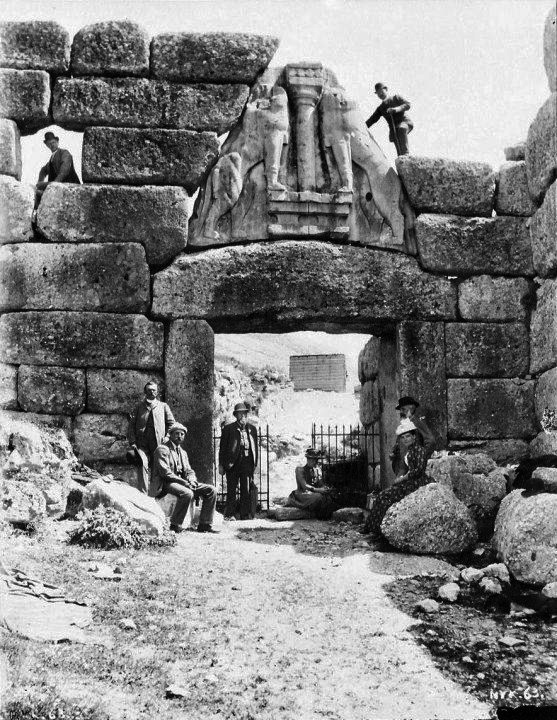
A group of archaeologists, including Schliemann, in Mycenae


At this point someone might get impatient, and ask: but Troy, then? Heinrich Schliemann has well discovered a city in Asia Minor! At least this is what is taught and believed to be true today in many universities: the beautiful tale of the adventurous pioneer who, risking his economic fortune and fighting against the doom and hostility of the dull nineteenth-century academic world, succeeds, comparing them with the pages of the Iliad, to perfectly identify the ruins of the city of Priam near the coasts of Turkey, to recover its fabulous treasures and deservedly earn the undying fame of "father of archaeology". Actually, the identification of the Turkish site of Hissarlik with the city of the siege has always perplexed scholars; many authoritative archaeologists today tend to emphasize differences rather than analogies. For example, geological studies show that the wide alluvial plain at the base of the hill on which Troy would have risen did not yet exist at the time of the 12th century BC, a date which is commonly considered to be the most likely for the event of the war. This means that there was no wide beach where more than a thousand ships could park, there was no plain where the chariots could run, and there was not even a battlefield! Furthermore, Schliemann, anxious to search for the treasures of ancient Troy, made considerable disasters, brutally uncovering the various archaeological layers and damaging them irreparably. He believed to find the "treasure of Priam" in the second layer (dating back at least a thousand years before the alleged date of the war), later identifying the city of the siege with the sixth or seventh layer (here the archaeological layers have been numbered in progressive order from the deepest, which is also the oldest, to the most superficial and recent). Furthermore, Schliemann himself was anything but an irreproachable character, and his autobiography, which many know, is largely "fictional": several episodes cited are invented from scratch, such as the story of his meeting with the president of the United States, the presence in San Francisco during the famous fire of the city, the same desire to discover the remains of Troy from an early childhood, and much more. It seems that much of his wealth came from having fake the scales with which he was trading gold with miners in California, and also he even risked being arrested for bigamy! In this regard, we refer to the well-documented essay by David A. Traill: Schliemann of Troy: Treasure and Deceit, where the professor of classical literature at California University paints a much less flattering portrait of the German archaeologist than that disclosed by himself and his admirers. To give an example of his working method, having read that in Troy there was a hot and a cold spring, he thought it best to measure the water temperature of all the streams in the area: correct application of the scientific method, we should to say, except that, since the temperature was the same everywhere, he concluded that perhaps the hot spring had run out and therefore the place he said was fine anyway! Particularly serious are the accusations of having altered the results of his excavations with objects found elsewhere, perhaps bought or even counterfeited, distorting many archaeological data and even falsifying his own diaries to prove certain claims. In fact, the most sensational findings would have occurred, in a very strange and suspicious way, in the absence of witnesses. Even the handsome guy boasted of his own unfairness towards other archaeologists who had to oversee the excavations, heavily invading the areas of their competence, and illegally smuggled the most precious pieces, ignoring the agreements signed with the local authorities. Traill, however, still seems to hesitate in the idea of ​​completely demolishing the geographical location of the ruins of Troy.


The excavations of "Troy" - Hissarlik, Turkey


However, many archaeologists think differently. For example, prof. Dieter Hertel (who teaches Classical Archeology at the University of Cologne and took part in several excavation campaigns in the Hissarlik area), in his book Troia , after having premised that "among the many layers that testify to the various reconstructions of Troy after each destruction that took place over the centuries, the Troy phases VI (1700-1300) and Troy VII (XIII century) were not the scene of famous military enterprises ", he underlines that" it is not possible to speak of an expedition of Mycenaean Greeks against the city, whether it was Troy VI or Troy VIIa [.. .] The study of the Trojan phases I-VII [...] has revealed to us the contours of a long historical epoch, with completely different characters from those of the world and of the events described by Homer ». Furthermore, "there is no indication that the end of Troy VI, VIIb1 and VIIb 2 can be attributed to a conquest [...] Even if Troy VIIa was taken by force, this event could not have found reflected in the Greek saga: not even the slightest clue supports this possibility ". Moreover, adds Hertel, “in the surroundings of Troy no sign of a siege contemporary to the layers of destruction found in the excavation of the city, brought by Mycenaean Greeks or other peoples, has been found; neither trenches, nor fortified camps for ships, nor anything similar has been discovered in the outskirts of the city, on the north coast or in the bay of Beşika, despite the numerous and arduous searches carried out ». It should be noted that tourists visiting the excavations are often taken to see remains such as the so-called "Ajax's tomb": it is a pity that these archaeological finds date back to Roman times, about a millennium after Homer, and were built to make the people happy, even then numerous travelers from Rome, including some emperors, who were fascinated to discover what Virgil had told to be the "roots" of the ancient Romans! We transcribe verbatim what Stuart Kelly's Book of Lost Books says about Homer, taking up the aforementioned Agon between Homer and Hesiod: "The emperor Hadrian tried to unravel those contradictory accounts by asking the sibyl Pythia for an opinion, who replied:" Ithaca it is his homeland, Telemachus his father, and Epicasta, daughter of Nestor, the mother who bore him, a man who is by far the wisest of mortals ”. If he was right, and if Telemachus, son of Ulysses, was Homer's ancestor, the Odyssey is a biography of his grandfather as well as an epic poem "and therefore, we add, a hagiographic device to legitimize his power over Ithaca. Thus the Pythia, who was at the head of the oracle of Delphi, could perhaps be aware of some "mystery", well kept and well handed down for generations. Not bad the idea of ​​Homer, son of Telemachus, who writes the history of the noble dinasty... It should be added that if you look at Homer's descriptions of Troy, for example in books XII and XX of the Iliad, you realize that the ancient stone city of the site of Hissarlik, founded five thousand years ago on the Turkish coast, has very little in common with what appears to be a typical Nordic European fortified village. Homer reports that the walls of the Achaean camp are even more impressive than those of Troy, but that they are partly demolished during a Trojan attack, and then swept away by the next flood of the river. Troy itself was then completely destroyed by a fire: all this suggests that it was largely made of wood; Homer points out that only the houses of the members of the royal family were made of stone. 


Rural village in the open-air museum in Olsztynek, Poland. This is how the houses of the protagonists of the Homeric poems must have been.

Consider how much effort it made centuries after Julius Caesar to make capitulate Alesia, the city of the Gauls, to realize how difficult the villages of Northern Europe were to conquer, despite being protected only by sturdy log palisades, sometimes reinforced with stones. It should also be noted that the remains of the Gallic city have not yet been identified with certainty, despite intense research and although its existence has never been questioned: it could be the same thing that happened to the Northern Troy, which would in any case be well different from the mighty stone fortresses imagined by Schliemann and which we are used to seeing in historical films and documentaries. At this point one can also think, taking up the observations of some historians of ancient Greece, that the famous "Trojan Horse" was actually a kind of "war machine", not very dissimilar from those designed by Caesar to conquer Alesia. There is also to consider the propensity of the Nordic peoples to drink and get drunk in an exaggerated way, well testified by all historical sources: Troy was destroyed because its inhabitants, deluded that the enemies were gone, did not put anyone on guard and they gave themselves to mad joy so much that they were all dead drunk! The Trojan hero Aeneas then states (Iliad XX, 219-240) that the foundation of his city dates back to less than six generations earlier, that is, about 200 years before; so if the war dated to 1200 BC, and the foundation to 1400, there would be "just" 1600 years of difference with the real date of birth of the Turkish city, which stratigraphic investigations place in 3000 BC! In short, despite the fact that in ancient times there were continuous wars, and fires in the inhabited areas were rather common events, it is not possible to find the so-called "smoking gun" that is able to prove an unequivocal correlation between the archaeological remains of Hissarlik and the events of the war, and the destruction of Troy so accurately described in the poems. Times and places do not square. In short, there is no what should be there, and there is what shouldn't be there! At the end of this speech, therefore, archaeologists would have every reason to breathe a good sigh of relief at the thought that the glorious city sung by Homer is not that heap of rubble devastated by the "mythical" Schliemann! The much-maligned nineteenth-century academic world had good reasons to be wary of that adventurer, and it is time for the current academic world to do so too. But the story does not end there: in 1912 a certain Paul Schliemann, self-styled grandson of Heinrich, sold a long article to a newspaper, complete with amazing details, in which he claimed that his grandfather had left him a series of archaeological finds and clues for discover none other than the lost civilization of Atlantis. The matter obviously aroused a certain sensation, and the good Paul, a worthy heir (real or presumed) of his grandfather, enjoyed for a short time an undeserved fame. But then, when his claims began to be scrutinized more carefully and turned out to be completely unsubstantiated, the good grandson preferred to disappear from circulation, not before declaring with shameless cheek: "But if I had to say everything I know, where would the mystery end? ". However, if you have a little patience, in a few pages we will also investigate the question of Atlantis and other mythological enigmas: as you can see, we do not miss anything. So, returning to Homeric geography, the Troy of Turkey is none other than one of the many cities so called, as there is one in Puglia, one in Portugal, a Troyes in France, a Troynovant in ancient England, not to mention of the twenty or so of Troy in the USA. In the case of Ilion we have two Ilions in Greece and one in New York. Moreover, this mechanism of calling different places with the same name has continued to perpetuate itself from antiquity to the present day: just think that the term Eridanus in ancient times indicated a European river (it was never understood whether the Rhone or the Rhine, or any other) and then designated the Po river in Italy. Or how many Olympus mountains there are: seven between Greece and Turkey, some others scattered around the world, including one in America, and one even on Mars! In practice, whenever a mountain higher than the others was encountered, someone promptly baptized it with the name of the seat of the deities. It is the same thing that astronomers have been doing since the dawn of time and still today, when they have to baptize some new planet, or satellite, or comet, and draw heavily from mythology. So Schliemann did not discover Homeric Troy, but only an important city of antiquity which was then called that. It would now be interesting to find out which city it was, perhaps it is precisely what the Hittites called Wilusa (even if its geographical location would seem different), which was later confused by the ancients for its assonance with the Homeric Ilium. After all, that of the German amateur archaeologist was not a particularly difficult undertaking: he was a rich merchant, who traveled a lot and was passionate about archeology, at a time when wealthy travelers were very few, and archaeologists even fewer. It was enough just to ask around and leave a few tips, to discover interesting remains. Good times! To find out where the ancient Troy was https://cunninghomer.blogspot.com/2018/05/homer-told-of-some-nordic-sagas.html


The e-book THE CUNNING HOMER in English (translated by the author) is now ready  (may 2023). I thank now who can provide me with useful corrections for my not perfect English. If you are a publisher and you want to publish the book you can contact me! If you are a professional translator and you think you can propose it to a publisher, contact me!

To buy the ebook it is sufficient that you send an email to alberto.majrani@tiscali.it with your commitment. University professors, museum directors and journalists will receive the ebook for free on a simple request.

The price of the ebook it is € 6.28 (like two pi Greeks!). You will be contacted when the book is ready with the payment instructions

If you want to read the book L'ASTUTO OMERO in Italian you can click here https://astutoomero.blogspot.com/

And if you have any doubts, ask alberto.majrani@tiscali.it !!!