Alberto Majrani THE CUNNING HOMER and the ingenious deception of the Odyssey

Who killed the suitors in Homer’s Odyssey?? A careful reading of the epic poem reveals a myriad of clues left by Homer with a surprising conclusion: the mysterious stranger, who arrived in Ithaca after twenty years and that no one was able to recognize was not Ulysses! But then, who could he really be? He was the expert Achaean archer Philoctetes in disguise! With this key, the Homeric poem suddenly assumes a logic and coherence hitherto unsuspected. This explains why Homer continues to praise the art of deception: it is he who has deceived us for three thousand years! And the surprises do not end there: all the apparent inconsistencies of the Iliad and the Odyssey that have plagued students and teachers for generations, known as the "Homeric Question", now fall effortlessly in place. The ancient texts finally agree with historical and archaeological data, fully revealing the genius of their author. Investigating the naturalistic, geographical and astronomical aspects with the right scientific key, it turns out that many myths are not only beautiful fairy tales, but arise from real events whose origin is only now beginning to be glimpsed.

venerdì 10 febbraio 2023

Funeral of "Patroclus" in Germany
The description, very rich in details, of the funeral of Patroclus (Iliad, book XXIII), fully recalls the characteristics of Celtic or Germanic funerals, with the sacrifice of twelve young Trojan prisoners, rams, oxen, dogs, horses, and with the collection of ashes in a golden urn: in Greek archeology metal urns begin to be found in the 12th century BC, but they suddenly become much more common only in the 8th century. In 2020, the burial of a Germanic nobleman from the 5th century AD was found in the locality of Brücken-Hackpfüffel, in Saxony, in which there were the sacrificed bodies of cattle, horses, dogs and six young women, proving the persistence even of certain bloody rituals. (from my book THE CUNNING HOMER.....  now ready  (may 2023))


domenica 15 maggio 2022

The father of archeology, or of fantasy archeology?


Chapter 16 - HERE THE CUNNING SCHLIEMANN WILL BE TOLD


"You can fool all the people some of the time and some of the people all the time, but you cannot fool all the people all the time." Attributed to Abraham Lincoln


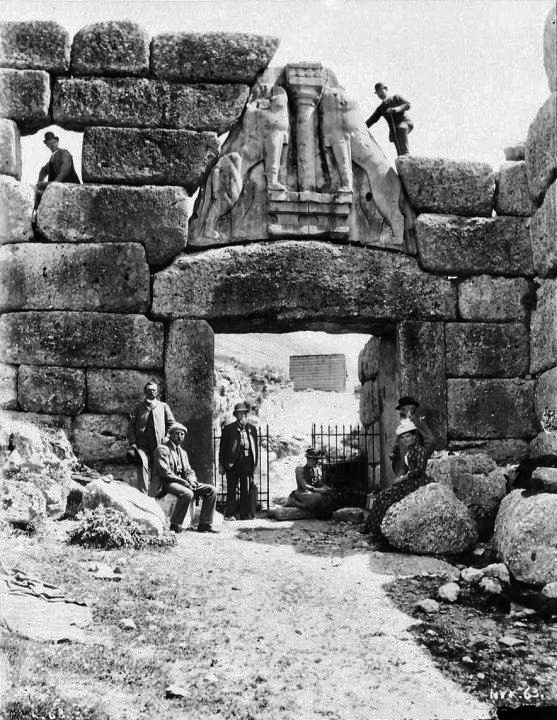
A group of archaeologists, including Schliemann, in Mycenae


At this point someone might get impatient, and ask: but Troy, then? Heinrich Schliemann has well discovered a city in Asia Minor! At least this is what is taught and believed to be true today in many universities: the beautiful tale of the adventurous pioneer who, risking his economic fortune and fighting against the doom and hostility of the dull nineteenth-century academic world, succeeds, comparing them with the pages of the Iliad, to perfectly identify the ruins of the city of Priam near the coasts of Turkey, to recover its fabulous treasures and deservedly earn the undying fame of "father of archaeology". Actually, the identification of the Turkish site of Hissarlik with the city of the siege has always perplexed scholars; many authoritative archaeologists today tend to emphasize differences rather than analogies. For example, geological studies show that the wide alluvial plain at the base of the hill on which Troy would have risen did not yet exist at the time of the 12th century BC, a date which is commonly considered to be the most likely for the event of the war. This means that there was no wide beach where more than a thousand ships could park, there was no plain where the chariots could run, and there was not even a battlefield! Furthermore, Schliemann, anxious to search for the treasures of ancient Troy, made considerable disasters, brutally uncovering the various archaeological layers and damaging them irreparably. He believed to find the "treasure of Priam" in the second layer (dating back at least a thousand years before the alleged date of the war), later identifying the city of the siege with the sixth or seventh layer (here the archaeological layers have been numbered in progressive order from the deepest, which is also the oldest, to the most superficial and recent). Furthermore, Schliemann himself was anything but an irreproachable character, and his autobiography, which many know, is largely "fictional": several episodes cited are invented from scratch, such as the story of his meeting with the president of the United States, the presence in San Francisco during the famous fire of the city, the same desire to discover the remains of Troy from an early childhood, and much more. It seems that much of his wealth came from having fake the scales with which he was trading gold with miners in California, and also he even risked being arrested for bigamy! In this regard, we refer to the well-documented essay by David A. Traill: Schliemann of Troy: Treasure and Deceit, where the professor of classical literature at California University paints a much less flattering portrait of the German archaeologist than that disclosed by himself and his admirers. To give an example of his working method, having read that in Troy there was a hot and a cold spring, he thought it best to measure the water temperature of all the streams in the area: correct application of the scientific method, we should to say, except that, since the temperature was the same everywhere, he concluded that perhaps the hot spring had run out and therefore the place he said was fine anyway! Particularly serious are the accusations of having altered the results of his excavations with objects found elsewhere, perhaps bought or even counterfeited, distorting many archaeological data and even falsifying his own diaries to prove certain claims. In fact, the most sensational findings would have occurred, in a very strange and suspicious way, in the absence of witnesses. Even the handsome guy boasted of his own unfairness towards other archaeologists who had to oversee the excavations, heavily invading the areas of their competence, and illegally smuggled the most precious pieces, ignoring the agreements signed with the local authorities. Traill, however, still seems to hesitate in the idea of ​​completely demolishing the geographical location of the ruins of Troy.


The excavations of "Troy" - Hissarlik, Turkey


However, many archaeologists think differently. For example, prof. Dieter Hertel (who teaches Classical Archeology at the University of Cologne and took part in several excavation campaigns in the Hissarlik area), in his book Troia , after having premised that "among the many layers that testify to the various reconstructions of Troy after each destruction that took place over the centuries, the Troy phases VI (1700-1300) and Troy VII (XIII century) were not the scene of famous military enterprises ", he underlines that" it is not possible to speak of an expedition of Mycenaean Greeks against the city, whether it was Troy VI or Troy VIIa [.. .] The study of the Trojan phases I-VII [...] has revealed to us the contours of a long historical epoch, with completely different characters from those of the world and of the events described by Homer ». Furthermore, "there is no indication that the end of Troy VI, VIIb1 and VIIb 2 can be attributed to a conquest [...] Even if Troy VIIa was taken by force, this event could not have found reflected in the Greek saga: not even the slightest clue supports this possibility ". Moreover, adds Hertel, “in the surroundings of Troy no sign of a siege contemporary to the layers of destruction found in the excavation of the city, brought by Mycenaean Greeks or other peoples, has been found; neither trenches, nor fortified camps for ships, nor anything similar has been discovered in the outskirts of the city, on the north coast or in the bay of Beşika, despite the numerous and arduous searches carried out ». It should be noted that tourists visiting the excavations are often taken to see remains such as the so-called "Ajax's tomb": it is a pity that these archaeological finds date back to Roman times, about a millennium after Homer, and were built to make the people happy, even then numerous travelers from Rome, including some emperors, who were fascinated to discover what Virgil had told to be the "roots" of the ancient Romans! We transcribe verbatim what Stuart Kelly's Book of Lost Books says about Homer, taking up the aforementioned Agon between Homer and Hesiod: "The emperor Hadrian tried to unravel those contradictory accounts by asking the sibyl Pythia for an opinion, who replied:" Ithaca it is his homeland, Telemachus his father, and Epicasta, daughter of Nestor, the mother who bore him, a man who is by far the wisest of mortals ”. If he was right, and if Telemachus, son of Ulysses, was Homer's ancestor, the Odyssey is a biography of his grandfather as well as an epic poem "and therefore, we add, a hagiographic device to legitimize his power over Ithaca. Thus the Pythia, who was at the head of the oracle of Delphi, could perhaps be aware of some "mystery", well kept and well handed down for generations. Not bad the idea of ​​Homer, son of Telemachus, who writes the history of the noble dinasty... It should be added that if you look at Homer's descriptions of Troy, for example in books XII and XX of the Iliad, you realize that the ancient stone city of the site of Hissarlik, founded five thousand years ago on the Turkish coast, has very little in common with what appears to be a typical Nordic European fortified village. Homer reports that the walls of the Achaean camp are even more impressive than those of Troy, but that they are partly demolished during a Trojan attack, and then swept away by the next flood of the river. Troy itself was then completely destroyed by a fire: all this suggests that it was largely made of wood; Homer points out that only the houses of the members of the royal family were made of stone. 


Rural village in the open-air museum in Olsztynek, Poland. This is how the houses of the protagonists of the Homeric poems must have been.

Consider how much effort it made centuries after Julius Caesar to make capitulate Alesia, the city of the Gauls, to realize how difficult the villages of Northern Europe were to conquer, despite being protected only by sturdy log palisades, sometimes reinforced with stones. It should also be noted that the remains of the Gallic city have not yet been identified with certainty, despite intense research and although its existence has never been questioned: it could be the same thing that happened to the Northern Troy, which would in any case be well different from the mighty stone fortresses imagined by Schliemann and which we are used to seeing in historical films and documentaries. At this point one can also think, taking up the observations of some historians of ancient Greece, that the famous "Trojan Horse" was actually a kind of "war machine", not very dissimilar from those designed by Caesar to conquer Alesia. There is also to consider the propensity of the Nordic peoples to drink and get drunk in an exaggerated way, well testified by all historical sources: Troy was destroyed because its inhabitants, deluded that the enemies were gone, did not put anyone on guard and they gave themselves to mad joy so much that they were all dead drunk! The Trojan hero Aeneas then states (Iliad XX, 219-240) that the foundation of his city dates back to less than six generations earlier, that is, about 200 years before; so if the war dated to 1200 BC, and the foundation to 1400, there would be "just" 1600 years of difference with the real date of birth of the Turkish city, which stratigraphic investigations place in 3000 BC! In short, despite the fact that in ancient times there were continuous wars, and fires in the inhabited areas were rather common events, it is not possible to find the so-called "smoking gun" that is able to prove an unequivocal correlation between the archaeological remains of Hissarlik and the events of the war, and the destruction of Troy so accurately described in the poems. Times and places do not square. In short, there is no what should be there, and there is what shouldn't be there! At the end of this speech, therefore, archaeologists would have every reason to breathe a good sigh of relief at the thought that the glorious city sung by Homer is not that heap of rubble devastated by the "mythical" Schliemann! The much-maligned nineteenth-century academic world had good reasons to be wary of that adventurer, and it is time for the current academic world to do so too. But the story does not end there: in 1912 a certain Paul Schliemann, self-styled grandson of Heinrich, sold a long article to a newspaper, complete with amazing details, in which he claimed that his grandfather had left him a series of archaeological finds and clues for discover none other than the lost civilization of Atlantis. The matter obviously aroused a certain sensation, and the good Paul, a worthy heir (real or presumed) of his grandfather, enjoyed for a short time an undeserved fame. But then, when his claims began to be scrutinized more carefully and turned out to be completely unsubstantiated, the good grandson preferred to disappear from circulation, not before declaring with shameless cheek: "But if I had to say everything I know, where would the mystery end? ". However, if you have a little patience, in a few pages we will also investigate the question of Atlantis and other mythological enigmas: as you can see, we do not miss anything. So, returning to Homeric geography, the Troy of Turkey is none other than one of the many cities so called, as there is one in Puglia, one in Portugal, a Troyes in France, a Troynovant in ancient England, not to mention of the twenty or so of Troy in the USA. In the case of Ilion we have two Ilions in Greece and one in New York. Moreover, this mechanism of calling different places with the same name has continued to perpetuate itself from antiquity to the present day: just think that the term Eridanus in ancient times indicated a European river (it was never understood whether the Rhone or the Rhine, or any other) and then designated the Po river in Italy. Or how many Olympus mountains there are: seven between Greece and Turkey, some others scattered around the world, including one in America, and one even on Mars! In practice, whenever a mountain higher than the others was encountered, someone promptly baptized it with the name of the seat of the deities. It is the same thing that astronomers have been doing since the dawn of time and still today, when they have to baptize some new planet, or satellite, or comet, and draw heavily from mythology. So Schliemann did not discover Homeric Troy, but only an important city of antiquity which was then called that. It would now be interesting to find out which city it was, perhaps it is precisely what the Hittites called Wilusa (even if its geographical location would seem different), which was later confused by the ancients for its assonance with the Homeric Ilium. After all, that of the German amateur archaeologist was not a particularly difficult undertaking: he was a rich merchant, who traveled a lot and was passionate about archeology, at a time when wealthy travelers were very few, and archaeologists even fewer. It was enough just to ask around and leave a few tips, to discover interesting remains. Good times! To find out where the ancient Troy was https://cunninghomer.blogspot.com/2018/05/homer-told-of-some-nordic-sagas.html


The e-book THE CUNNING HOMER in English (translated by the author) is now ready  (may 2023). I thank now who can provide me with useful corrections for my not perfect English. If you are a publisher and you want to publish the book you can contact me! If you are a professional translator and you think you can propose it to a publisher, contact me!

To buy the ebook it is sufficient that you send an email to alberto.majrani@tiscali.it with your commitment. University professors, museum directors and journalists will receive the ebook for free on a simple request.

The price of the ebook it is € 6.28 (like two pi Greeks!). You will be contacted when the book is ready with the payment instructions

If you want to read the book L'ASTUTO OMERO in Italian you can click here https://astutoomero.blogspot.com/

And if you have any doubts, ask alberto.majrani@tiscali.it !!!


martedì 10 maggio 2022

HOW WAS THE BOW OF ULYSSES MADE? AND WHY WERE THE SUITORS NOT ABLE TO TEND IT?


  In a previous post http://cunninghomer.blogspot.com/2016/08/the-cunning-homer.html , we saw how the whole story of the Odyssey becomes extremely logical and realistic once you drastically changed the perspective of the Homeric narrative. Ulysses was not ... Ulysses, but the one whom Ulysses himself presents as the best of the Achaean archers, that is, Philoctetes: a mercenary hired by Telemachus to interpret the King of Ithaca and get rid of all the suitors. Let's now examine one of the most important scenes of the Odyssey in this light: that of the challenge with the bow. As will be remembered, the suitors have tried in vain to extend the weapon, but now the task falls to Ulysses, or whoever works for him. But now let's get back to our story; we were left at the dramatic moment of the challenge with the bow: evidently, Ithaca was not a land of archers, in fact no one seems to know what to do. Telemachus and one of the suitors try first, but they can't even pull the rope. Only Antinous, who has a little more experience, realizes that the bow must first be heated and greased to function, so he orders the fire to be lit. Nevertheless, all the suitors, except Eurimachus and Antinous, the strongest of all, try in vain to stretch him. At this point the beggar nods to Eumeus and Philetius and goes out with them from the hall. And here he "reveals" to the two men that he is Ulysses, asking for their help in carrying out his revenge and promising a notable reward: 

 To both I will give a bride, wealth I will give; and a house built next to mine; for the future companions and brothers you will be, for me, of Telemachus (XXI, 214-216).  

Pay attention: he does not say "you will be my companions and brothers" or "you will be like my sons", but "for me you will be companions and brothers of Telemachus". It is evident that who is speaking is not the king of Ithaca Ulysses, but another one. And to be recognized, he removes the rags and shows the scar on his knee: we have already seen how this "proof" had very little value. They then return to the hall, while Eurimachus complains of not being able to draw the bow. So Antinous, to avoid bad impressions, proposes to postpone the race to the next day, with the excuse that, evidently, the god Apollo does not want him to show off his skills on his feast day. And then Philoctetes, with the most innocent air in the world, asks to try him too, to see if a little of his ancient strength remains in his tired limbs. Of course the suitors feel offended to be challenged by such a beggar, but Penelope intervenes by replying that even if the foreigner manages to draw the bow, she will not marry him, but that honors and rich gifts will still be bestowed upon him. Even Telemachus, amid the screams of the suitors, approves. And then he orders his mother to retire to her rooms, an order that Penelope immediately executes without discussion, while the cowherd and the swineherd block the doors to prevent any escape during the slaughter. Then "Ulysses" takes the bow in his hand, beginning to examine it and carefully palpate it, so much so that two young people comment:  

Of course he was an expert, a practical man of bows. And perhaps he too has similar bows in his house (XXI, 397-398). 

 Clearly, no one in Ithaca had ever seen a bow of that type: it is therefore likely that Philoctetes had brought it with him from home. Perhaps it had been hidden among the so-called gifts that Menelaus had given to Telemachus: in fact, when Penelope takes it to carry it into the room, she takes it out of his case, who was in turn among the arks containing his robes. So it is plausible that no one had seen it while it was being introduced into the palace. But is it possible that a group of bold young men in full force were so wimpy that they could not draw a bowstring? Are we struggling with another divine intervention? Here we are probably faced with an interpretative misunderstanding of a technical nature, which can only be resolved by knowing some fundamental construction details of ancient bows. Those who are not familiar with the subject are led to think that a bow is just a curved piece of wood with a string stretched at the ends. In fact, since ancient times, there were much more complex bows, made of wood and animal horn, as described by Homer. But not only that: the string was stretched between the two ends through a complicated movement, which consisted in extending the bow with force, using the knee to leverage, in the REVERSE direction to its natural curvature in the rest position. At that point the archer slipped the rope, already prepared with two loops at the ends, into two grooves at the ends of the bow itself. In this way, was obtained a weapon of considerable tension and range. Of course, such this operation could only be carried out correctly by a well-trained individual, and not by boys without experience. Moreover, this type of bow could not be kept permanently in tension, since within a few days it would lose most of its elasticity and power. And if it really had been the bow of Ulysses, which had remained there to mold for twenty years, it could have broken after a few pitches: a risk, obviously, that could not be run; Homer knows this well, and in fact he says that his protagonist carefully observes the weapon, to check that it is not damaged by woodworms. Of course, if it had really been worm-eaten, all of Ulysses' terrible "revenge" would have sunk into ridicule. So we must think that the bow was a tool in full efficiency, and had been introduced by stealth. Therefore, even this scene, examined with due attention, loses its miraculous character to become extremely realistic. 


 As you can see in the photo, the notches where the string should be inserted are now on the INTERNAL side of the bow in the rest position, but would be correctly located on the outside once the overturning operation has been completed. These in the image are in the medieval museum of Bologna, they are Turkish weapons of the seventeenth century, but in any case the technology has remained unchanged for millennia, as we see in an amphora of the fourth century BC, found in the kurgan of Kul'Oba, now in the Hermitage in St. Petersburg, showing a Scythian warrior crouched in the act of stringing his bow. Behind the back you can see the gorito, the typical case for the bow and arrows. Below, Scythian archer, from Vulci, 510 BC, and operating scheme of the compound bow (from Le Scienze, August 1991). These are the so-called Scythian-type bows, which were widespread everywhere, but which take their name from the Scythians, a population of nomadic horsemen who roamed a vast territory of the steppes from Siberia to the Black Sea. Its small size made it suitable for use on horseback.

A legend, collected by Herodotus, tells that Hercules had conceived three children with a mysterious serpent woman, and had left her one of his two bows so that he would give it as an inheritance to that of his children who were able to hold it. The winner was called Scythian (or Scite) and would have been the progenitor of the people of the Scythians. The analogies with the events we have told so far are evident. As is often the case, myths tend to repeat themselves in a similar way in different places and times. We had seen that the wound in Philoctetes' foot was caused by a snake (according to Homer) or by one of his own arrows (according to other versions): but perhaps one thing does not exclude the other! The Scythians were in fact famous for the poisons they used to make their arrows more lethal, which were prepared with a deadly mixture of dung, rotten human blood and viper venom; moreover, the arrows could be equipped with hooks that broke in the victim's body when an attempt was made to extract them: therefore the description of Philoctetes' infected wound, painful, putrid and stinking, which can only be healed with a complicated surgical operation, agrees perfectly with the damage done by a Scythian arrow. 

Chemical and biological wars are not an invention of modernity! Furthermore, as Professor Giuseppe Girgenti points out, the Greek adjective "toxic" (τοξικός) derives from the Greek term τόξον, which means "bow" (but also "rainbow"), and was an attribute of the bow and arrow deities, namely Apollo, Artemis and Eros. Heraclitus attributes to Apollo the harmony of the bow and the lyre, and Plato, in "Cratylus" (405a) argues that there were four typical arts of Apollo, namely "music" (μουσική), "prophecy" (μαντική), "medicine" (ἰατρική) and the "toxic art" (τοξική), which is precisely the art of the archer. Now, it was customary in the Greek world to smear the arrowheads with a poison, the so-called "toxic drug" (τοξικόν φάρμακον), which was to be lethal in war, or only serve to stun large animals during hunting, such as horses and elephants (as Aristotle, Strabo and Aelian tell us). But from here the adjective "toxic" has come to mean something poisonous or in any case something pharmacological that has the effect of stuning and numbing, that is, all kinds of drugs. Now we understand why Achilles dies from a wound on the heel, certainly not a vital organ, caused by an arrow shot by Paris, who is often represented as a typical Scythian archer!And now Philoctetes stretches the bowstring, takes aim, shoots the arrow and inserts the rings of the twelve axes on the first shot, to general amazement. And Telemachus stands next to him fully armed: it's time to change targets.

 POST SCRIPTUM:
when I looked at the statistics of visits to the italian version of this site, I wondered why there was so much interest in the bow of Ulysses... then I bought TOPODISSEA on the newsstand, which reprinted a story from 2018, and I understood... I don't know if exist an English version of it...


The e-book THE CUNNING HOMER in English (translated by the author) is now ready. I thank now who can provide me with useful corrections for my not perfect English. If you are a publisher and you want to publish the book you can contact me! If you are a professional translator and you think you can propose it to a publisher, contact me!

To buy the ebook it is sufficient that you send an email to alberto.majrani@tiscali.it with your commitment. University professors, museum directors and journalists will receive the ebook for free on a simple request.

The price of the ebook it is € 6.28 (like two pi Greeks!). You will be contacted with the payment instruction. Yet you can pay with paypal https://www.paypal.com/paypalme/Majrani 

If you want to read the book L'ASTUTO OMERO in Italian you can click here https://astutoomero.blogspot.com/

And if you have any doubts, ask alberto.majrani@tiscali.it !!!

lunedì 19 luglio 2021

Eustathius, horn, ivory and false dreams

 A greek professor wrote to me: “A passage in the Odyssey has been puzzling me for a long time: when Penelope tells Odysseus, who is still incognito at this moment, about two different kinds of dreams. The ones which pass through the gates of horn accomplish real things, whereas those coming forth from the gates of ivory are false and deceptive. Penelope does not believe in her dream of Odysseus returning home, because it came forth from the gates of ivory. Od.19.562– 567. This to me sits well with your interpretation that it was not Odysseus that returned. Please give me your feed back on this.” I talk about it at page 116 of my book L’ASTUTO OMERO! : “Penelope tells of having dreamed of twenty geese (male geese!) pecking grain (number twenty returns) and that an eagle arrives and kills them. It is interesting to note the presence of another pun that is lost in translation; dreams, says Penelope, can enter through two doors: those of the ivory door (ἐλέφας- elefas) deceive (ἐλεφαίρονται – elefairontai), while those of the  horn door (κέρας- keras) present things that are true (ἔτυμα κραίνουσι – etyma krainousi) and therefore they are realized. Strangely, as Eustathius of Thessalonica had noted, for the ancients good and true things had an affinity with the most precious objects, but ivory is more precious than the horn: this contradiction, however, is resolved if we consider that the horn brings to mind the eye (the cornea, but also the pupil, κόρη, kore), while the ivory recalls the teeth, that is the mouth; in Homer the phrase “which word came out of the fence of your teeth” often resounds (Od. I, 64)); therefore one must believe in what is seen and not in what is said (and she sees well that what she has in front of her is not her husband).” 


The e-book THE CUNNING HOMER in English (translated by the author) is now ready  (may 2023). I thank now who can provide me with useful corrections for my not perfect English. If you are a publisher and you want to publish the book you can contact me! If you are a professional translator and you think you can propose it to a publisher, contact me!

To buy the ebook it is sufficient that you send an email to alberto.majrani@tiscali.it with your commitment. University professors, museum directors and journalists will receive the ebook for free on a simple request.

The price of the ebook it is € 6.28 (like two pi Greeks!). You will be contacted when the book is ready with the payment instructions

If you want to read the book L'ASTUTO OMERO in Italian you can click here https://astutoomero.blogspot.com/

And if you have any doubts, ask alberto.majrani@tiscali.it !!!

martedì 29 giugno 2021

THE SNEEZE OF TELEMACHUS!

 THE SNEEZE OF TELEMACHUS!
Here is one of the strangest and weirdest pieces of information we get from the Odyssey, since Penelope:

So he said, and Telemachus sneezed loudly, and the whole house
Fearfully echoed: Penelope then laughed,
And immediately to Eumeus fleeting words said:
“Go, invite the guest to come forth here:
Can’t you see that the son sneezes at all my words?
So would the death of the suitors come true, of all”. (XVII, 541-546)

It seems that Homer wants us to know that Telemachus sneezes, so that the fact is also remarked by his mother the queen, but what can be so special a sneeze, to deserve to appear in an immortal work? For us moderns maybe nothing, but for the ancients such a gesture was considered good luck, so that even today when someone sneezes we exclaim joyfully: “Salute! (Health!)”or “God bless you!”. Which is in itself quite strange, since often a sneeze is a symptom of the arrival of a more serious and annoying disease, such as fever or allergy, otitis or worse. According to the ancients the sneeze had to be of divine origin, being produced by a sacred part of the body, the head. So we say “Salute” to imply “May the gods bring you health instead of sickness” or something similar. Perhaps not many people know that Giacomo Leopardi, in addition to sad and pessimistic poems that have plagued for generations students who had to learn by heart, was also the author of an “Essay on the popular errors of the ancients” that had an entire chapter dedicated to sneezing. For us, the attention should be shifted not on the sneeze, but on its author, that is Telemachus: Homer wants us to know that the destiny of the annihilation of the suitors will be sanctioned by the divine will and will be fulfilled by Telemachus, and not by Ulysses. 


The e-book THE CUNNING HOMER in English (translated by the author is now ready  (may 2023) . I thank now who can provide me with useful corrections for my not perfect English. If you are a publisher and you want to publish the book you can contact me! If you are a professional translator and you think you can propose it to a publisher, contact me!

To buy the ebook it is sufficient that you send an email to alberto.majrani@tiscali.it with your commitment. University professors, museum directors and journalists will receive the ebook for free on a simple request.

The price of the ebook it is € 6.28 (like two pi Greeks!). You will be contacted when the book is ready with the payment instructions

If you want to read the book L'ASTUTO OMERO in Italian you can click here https://astutoomero.blogspot.com/

And if you have any doubts, ask alberto.majrani@tiscali.it !!!

domenica 20 giugno 2021

Homer, Telemachus, Ulysses, and the Summer Solstice


Homer, Telemachus, Ulysses, and the Summer Solstice

by Alberto Majrani


Apparent movements of the sun over the course of the year


In the previous interventions we have seen how the Homeric poems suddenly assume an extraordinary "coherence", once they are read with the right criterion and how many mysterious phrases become very clear for those who have a solid scientific background. Let's now see in this key one of the most dramatic moments of the Odyssey: the description of the massacre of suitors, by Ulysses (or whoever for him), his son Telemachus and faithful servants. But is it possible to understand on which day the crime takes place? The chief of suitors Antinous will give us a suggestion:


Today there is a solemn feast among the people (XXI, 258)


So this is not an ordinary day, but it is a day of celebration for all the people: in an age when few are able to use a calendar, if the conspirators have to make an appointment, they can only do it on a particular day, well known to all. A few verses later it turns out that the festival is dedicated to the archer god Apollo. Since Apollo was also the god of light, we can even venture the hypothesis that it could be a solar festival, such as the summer solstice, which was a particularly important day for the ancients. The summer solstice is the longest day of the year, while the winter solstice is the shortest. Often people unfamiliar with astronomy believe that the sun always rises exactly in the east and sets in the west: in reality, this only happens on the day of the spring or autumn equinox. During the other days of the year, the rise and sunset point gradually moves to the right or left. On the solstices, the sun rises and sets at the farthest point from the east and west: it is said that the "sun stays" because for a few days it seems to stop at a fixed point and then go back.


Summer solstice festival in Finland


Astronomical knowledge was already present in prehistoric times: many archaeologists think that even the animals painted in the famous Lascaux caves are a representation of the constellations. In 14000 BC, a period that agrees with the dating of the paintings obtained with other methods, the sun set on the summer solstice, lighting up the painted wall, located about forty meters from the entrance. It is definitely unlikely that this is due to chance, because there are many caves in the area and that is the only one painted, and the phenomenon only occurred on the days immediately close to the summer solstice.

If the observation is extended to southern France, we find about a hundred decorated caves from the Paleolithic era, and almost all of them are astronomically oriented. If we then consider the aesthetic quality of the paintings, we can realize how those distant ancestors of ours were anything but rough cavemen, and the intellectual abilities of the men of that era were practically identical to those of contemporary men. A similar phenomenon occurred in many other prehistoric temples, from the mound of Newgrange in Ireland, of 3200 BC, oriented towards the winter solstice, to that of Abu Simbel in Egypt, of 1200 BC, with the sun going to illuminate a room placed at the end of a long corridor only on two days a year, probably on the birthday and coronation anniversary of Pharaoh Ramses II.


Mound of Newgrange


Archaeological studies are now almost in agreement in believing that megalithic temples had functions of astral worship: their main orientations are almost always directed towards points of astronomical importance, such as the place of rising or setting of the sun at the solstices (or, more rarely, at the equinoxes), as well as the moon or the main stars and constellations on particular days of the year. The megaliths therefore also had a calendar function, essential for populations who had to know the right times for sowing or transhumance.


Abu Simbel at dawn; Abu Simbel the illuminated room


Archeoastronomy is a relatively "young" discipline, but by now its calculation and survey techniques have all the trappings of scientificity, even if it often risks being discredited by the work of many imaginative amateurs in search of complicated and improbable stellar connections.

This is the case, for example, of the most famous megalithic monument, the circle of Stonehenge, about which everything has been said, and even too much: many astronomical lucubrations are however not very credible also because in the last two centuries the site has been subjected to several restorations, as several stones had collapsed or been torn down. Although the restoration may have been accurate, we cannot be sure of the original orientation of the megaliths: surely, however, there was an alignment towards the sun at the summer solstice, since the ancient road that reached the complex had this direction. The historian Diodorus Siculus (1st century BC), citing the writings of other ancient Greek historians, mentions a large spherical temple of Apollo located on a Hyperborean island that could be identified with Great Britain: if the correlation with Stonehenge is correct, we can deduce that in Northern Europe Apollo was worshiped, as in Greece, and that his cult was linked to the summer solstice (others believe that Diodorus refers to the analogous circle of Callanish megaliths, located in the Hebrides, but the discourse does not change). Some burials of individuals from the Mediterranean basin, unearthed in the area of Stonehenge, indicate that the megalithic complex was a pilgrimage destination since prehistoric times.


Spectacular rainbow at Stonehenge


Almost all the religious buildings of antiquity continued to have a significant astronomical orientation: to give a fairly well-known example, in Milan the Duomo is oriented along the east-west axis, that is towards the position of the sun at dawn and sunset on the day of the equinox, while the Basilica of Sant'Ambrogio is oriented towards the position of the sun at the solstice. Even in many medieval churches, the windows are arranged so that the sun hits the frescoes of the saints in correspondence with the days on which they are celebrated. This type of knowledge has largely been lost in recent centuries, but those who knew how to interpret these celestial signs inevitably enjoyed great respect and authority. We find something very similar in the nineteenth book of the Odyssey: we are at sunset, all the suitors have gone to sleep in their homes, and the doors of the palace have been closed. Ulysses and Telemachus are preparing to hide the weapons hanging on the walls, taking torches to shed light, when suddenly the whole house lights up:


while in their path Pallas Athena

held up a golden lamp of the purest light.

Telemachus at last burst out: “Oh, Father,

here is a marvel! All around I see

the walls and roof beams, pedestals and pillars,

lighted as though by the white fire blazing near.

One of the gods of heaven is in this place!”

Then said Odysseus, the great tactician,

Be still: keep still about it: just remember it.

The gods who rule Olympos make this light.

You may go off to bed now. Here I stay

to test your mother and her maids again.

Out of her long grief, she will question me.”(XIX, 33-43)


therefore we have a further element to hypothesize that it was the day of the summer solstice: in light of what we know about the importance of astronomy for the ruler of antiquity, we can think that in the king's house there was a kind of window or slit oriented on the position of the sun at the summer solstice, which was used by the sovereign to calculate the years, and perhaps to create amazement among his subjects with a "prodigious" event. The winter solstice, on the other hand, should be excluded, because in ancient times navigation was limited to the summer period, and both Ulysses and Telemachus, as well as the herdsman Philoetius, had just arrived by ship. And of course, experienced sailors must have been familiar with astronomy. Moreover, when Telemachus had secretly left for his tour, Penelope was desperate that her son would undertake such a perilous journey, so the season of sailing must have just begun, and the risk of running into a storm was still well strong. It should be noted that the same goddess Athena stops the chariot of the sun before dawn to prolong the night of love between Ulysses and Penelope (XXIII, 241-246): a further indication that the night was particularly short, so much so as to make it indispensable precisely a miracle to delay the dawn. Finally, I add that in many parts of the world, the summer solstice is still celebrated with the lighting of large bonfires, and therefore also the fact that Antinous has a fire lit to heat the bow could be another clue. In a continuous game of references, there is a further link between fire and the bow, as anyone who has seen any documentary on primitive populations knows: to light the fire, you rub a stick in your hands, or rather you rotate with the help of the string of a bow that makes a spiral movement, like a snake climbing a tree; the movement is very similar to that of the drill, and Ulysses himself will claim to have worked his nuptial bed with the drill (XXIII, 197); and it is not for nothing that the attributes of Apollo are the bow and the serpents, as well as the lyre, to be related to the singer who is saved from the massacre. So, within a few pages, the same concept is repeated several times, albeit cryptically enough to make it incomprehensible until today.


This text is an excerpt from the long Chapter 18 - The sun and other stars, dedicated to astronomy in Homer 


The e-book THE CUNNING HOMER in English (translated by the author) is ready for april 2023. I thank now who can provide me with useful corrections for my not perfect English. If you are a publisher and you want to publish the book you can contact me! If you are a professional translator and you think you can propose it to a publisher, contact me!

To buy the ebook it is sufficient that you send an email to alberto.majrani@tiscali.it with your commitment. University professors, museum directors and journalists will receive the ebook for free on a simple request.

The price of the ebook it is now € 6.28 (like two pi Greeks!). You can click directly on https://www.paypal.com/paypalme/Majrani to send money with paypal (it's very simple and very safe)

If you want to read the book L'ASTUTO OMERO in Italian you can click here https://astutoomero.blogspot.com/

And if you have any doubts, ask alberto.majrani@tiscali.it !!!

mercoledì 18 novembre 2020

But... was Homer blind? NOOO!!!


Was Homer blind? NOOO! In his essay "Greek culture and the origins of European thought", the philologist Bruno Snell highlights how "Homer uses for example a great variety of verbs to denote the operation of sight: ὁρᾶν, ἰδεῖν, λεύσσειν, ἀθρεῖν, θεᾶσθαι, σκέπτεσθαι , ὄσσεσθαι, δενδίλλειν, δέρκεσθαι, παπταίνειν. Of these, several have gone out of use in later Greek, at any rate in prose literature and in the living speech […]. Only two words make their appearance after the time of Homer». I am not here to report the precise meaning of the various verbs, because I should often resort to long turns of words, and whoever wants can easily find the complete explanation on the internet, however it would be really strange if such a lexical richness to express the act of seeing was used by someone who cannot see. https://www.amazon.it/Discovery-Mind-Origins-European-Thought/dp/1621380335


The e-book THE CUNNING HOMER in English (translated by the author) will be ready for Christmas 2022. I thank now who can provide me with useful corrections for my not perfect English. If you are a publisher and you want to publish the book you can contact me! If you are a professional translator and you think you can propose it to a publisher, contact me!

To buy the ebook it is sufficient that you send an email to alberto.majrani@tiscali.it with your commitment. University professors, museum directors and journalists will receive the ebook for free on a simple request.

The price of the ebook it is € 6.28 (like two pi Greeks!). You will be contacted when the book is ready with the payment instructions

If you want to read the book L'ASTUTO OMERO in Italian you can click here https://astutoomero.blogspot.com/

And if you have any doubts, ask alberto.majrani@tiscali.it !!!